Friday, February 28, 2014

Hello everyone! Welcome to my blog! Today we have a special guest it's Scientificmeap! Scientificmeap: uuuuuuggggg why  did you make come all the way here its so much work is had to walk a yard to get here wwwaaahhh!!. Shut it! no one cares about your feelings! If you don't want to be here just leave! or better Security! Security! Get this lazy girl out of here!Now as i was saying today we are going to talk about Neptune.
http://www.bobthealien.co.uk/neptune.htm

The planet Neptune was mathematically predicted before it was discovered, by Urbain Le Verier, telescopic observations confirming the existence of a major planet were made on the night of September 23–24, 1846, at the Berlin Observatory,by Johann Gottfried Gall. Neptune was named after the roman god Neptune which is the god of the sea.
http://en.wikipedia.org/wiki/Johann_Gottfried_Galle

Neptune is different from the other gas giant planets because: Neptune is smaller then all the other gas giants, but it is similar to Uranus because it's atmosphere absorbs red light like Uranus that's Neptune has its pretty blue color. Neptune is similar to Jupiter because it has a great dark spot which is like Jupiter's red spot. Neptune is really similar to Uranus by color and size its only a little bit smaller. Unlike the other planets Neptune has a really long orbit around the sun it takes 164.79 years!. Also Neptune is the only planet to have a moon that orbits Neptune the opposite way Neptune spins.
http://www.arcadiastreet.com/cgvistas/neptune_0020.htm

 Now we are going to talk some of Nepune's storms. First w are going to talk about the Great Dark Spot. The Great Dark Spot was a huge spinning storm in the southern atmosphere of Neptune which was about the size of the entire Earth. Winds in this storm were measured at speeds of up to 1,500 miles per hour. These were the strongest winds ever recorded on any planet in the solar system! Wow that's some really strong winds! The Great Dark Spot was first discovered when the Voyager 2 spacecraft flew by Neptune in 1989. When the Hubble Space Telescope looked at Neptune in 1994, the Great Dark Spot was gone and a different dark spot had appeared in the northern atmosphere of Neptune.

Neptune's Small Spot is The Small Dark Spot, sometimes also called Dark Spot 2 or The Wizard's Eye, was a southern cyclonic storm on the planet Neptune. It was the second most intensive storm on the planet in 1989, when Voyager 2 flew by the planet. When the Hubble Space Telescope observed Neptune in 1994, the storm had disappeared.
                                            
The Storm nicknamed the Scooter is high level clouds that whip across the sky in the upper atmosphere.
                                           

It does snow on Neptune but it's not like snow on earth, it is of ammonia ice crystals. i
Neptune does have water because ice is present in the atmosphere of Neptune, which is comprised of water. Also, the interior of Neptune contains ice. Ice, and thus, water, can be found among the rock inside Neptune.  

                                                     
Neptune has thirteen moons that we know of. The largest moon is Triton. Triton is slightly smaller than Earth's Moon and has active volcanoes which erupt like geysers and eject nitrogen frost over the surface.
                                      

Guess what time it is! Its fun fact time!!!!!! Yaaayyy!! cough cough I mean lets get started.
1) Neptune is the 8th planet in the solar system.
2) Neptune's largest moon is Triton
3) Neptune has a lot of strong storms.


Thank you for reading my blog! OK Scientificmeap you can leave now! Scientificmeap: YAAYYY!!! WOOO HOOO OH YEAH!! I mean ok sure thanks for letting me be on your blog.


                                                                        Link1
                                                                        Link2
                                                                        Link3
                                                                        Link4
                                                                        Link5
                                                                        Link6

Sunday, February 9, 2014

Hello everybody! Welcome to my blog. Today we are going to talk about the planet Uranus. Well.... here we go.
http://en.wikipedia.org/wiki/Ice_giant
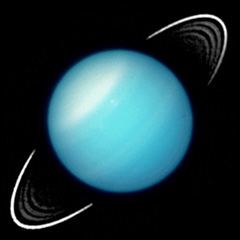
Uranus was discovered on March 30th 1781 by William Herschel. Uranus got its name from  Uranus is named after the ancient Greek god of the sky, who was the father of Kronos.
http://solarsystem2040.wordpress.com/2010/11/14/unveiling-uranus/
Yes Uranus does has rings here are some facts about them: Uranus has 9 brighter rings as well as several fainter rings. Some of the larger rings are surrounded by belts of fine dust. The outermost ring is made up of ice boulders several feet across. The other rings are made up mainly of icy chunks darkened by rocks. The rings are thin, narrow, and dark compared to the rings of other planets. 


Uranus has 27 moons that we know of. One of the bigger moons is Titania. Here is some information about Titania. Titania is Uranus's largest moon. A prominent system of large valleys, some nearly 1,000 miles long, are visible near the shadow line. The moon is about 1,600 km long in diameter. 
  
Uranus is a giant ball of ice and gas so you can't really say that is has a surface  If you tried to land a spacecraft on Uranus, it would just sink down through the upper atmosphere of hydrogen and helium, and into the liquid icy center. When you look at Uranus see the blue-green color that seems to come from the surface of Uranus. This color is light from the Sun reflected off Uranus’ surface. The atmosphere of Uranus contains hydrogen and helium, and most importantly, it has relatively large amounts of methane. This methane absorbs color in the red end of the spectrum of light, while photons at the blue end of the spectrum are able to reflect off the clouds and go back into space. So the full spectrum of the Sun’s light goes in, the red and orange end of the spectrum is absorbed, and the blue green end of the spectrum bounces back out. And this is why the surface of Uranus has its color.
                                         
Uranus is different from the other planets because Uranus has a very weird axis rotation. because its axis of rotation is tilted sideways, nearly into the plane of its revolution about the Sun. Its north and south poles therefore lie where most other planets have their equators.
                                   
Guess what time it is! It's Fun Fact Time! Here are some Fun Facts about Uranus!!!!!

1) Uranus is the 7th planet from the sun.

2) Uranus's largest moon is named Titania.

3) Uranus has 27 moons in total.

4) Uranus was discovered by William Herschel.

Thank you for reading my blog! This is Science Cat saying keep reading my blogs and have a very nice day. 


 has one of the most unusual orbital characteristics in the solar system. In contrast to most other planets, Uranus's ax moving in a large circle, Uranus is more like a barrel, rolling on its side in a bigger circle. The cause of this peculiarity is unknown, but one theory presents it as being the result of a collision between a massive body sometime in ts past. Thus, with the planet's south pole pointing toward the , Uranus receives more solar input in that area than it does on the equator! However, an unusual fact is that the equator is still hotter than any other area of the planet, a phenomena that remains currently unexplained.


                                                                        Link1
                                                                       Link2
                                                                       Link3
                                                                       Link4
                                                                       Link5
                                                                       Link6


Thursday, January 30, 2014


Hello everyone and welcome to  M NEWS and this is Science cat here my assistant Scientific Meap(cough Amisha)Scientific Meap: UUUUGGGG why did you make come here it took so much effort and oooowww now my mouth hurts from talking. Too bad! GET OVER IT! Now here is the news story for today. Cold climate is ..... Scientific Meap: CAN I GO HOME NOW! No now shush. As i was saying cold climate is is killing penguin chicks in Argentina.
Penguin chick survivor 
From 1983 to 2003 researchers based at the university of Washington in Seattle monitored a colony of 400,000 Magellanic penguins living halfway up the coast of Argentina on a peninsula  called Punta Tombo. Each year the researchers  visited penguin nests once or twice a day  from mid September to late February to asses the overall status of the colony and the health of the chicks once they hatched in late November or early December.

The resulting data set provides one of the largest ever records of a signal penguin colony. It revealed that starvation and predication were the most common and constant chick killers over the years, but hypothermia was the leading cause of death during years with many rainstorms, which became more prevalent through the study period .
    
Young chicks about 9-23 days old were particularly vulnerable to hypothermia as they were to young to have fully grown their waterproof plumage but already to big to seek shelter under their parents bodies the team reported on weds. Jan. 29th . They have to have water proof feather to survive, if they don't they  will die as soon as they hit the water.
 
Well I know it wasn't the best ending but thanks for listening to M News this Science cat saying keep loving penguins.
 

Thursday, January 16, 2014

Hi everyone! Today on my blog we are going to talk about a very awesome planet with many rings and moons. Today we are going to talk about Saturn! (Cough Cough this planet is my favorite)

Saturn is named after a character in Roman mythology. Saturn is named after the god Saturnus. Saturnus is the god of agriculture.
Saturn differs from the other planets because Saturn is bigger than all the other planets except for Jupiter. In fact the diameter of Saturn is 120,536 km in diameter not counting the rings. Also Saturn differs from he other planets because of how many moons orbit Saturn. Here is example Saturn has 60 moons orbiting it while Jupiter has 67 moons orbiting it. So basically it is very different form all the other planets.
Saturn is the planet with the lowest density. That means Saturn is lighter than water so if a pond or body of water big enough and Saturn went for a swim Saturn would float.
Now we are going to talk about my favorite part of Saturn it's rings! The rings are made up of small particles and can range in size from micrometers to meters that orbit around Saturn. The particles are made up of mostly water ice with a race component of a rocky material. Now we are going to talk about Saturn's atmosphere. The planet has a yellow haze due to ammonia crystals in it's upper atmosphere. Electrical current that is within it's metallic hydrogen layer is thought to give rise to Saturn's planetary magnetic field.

http://www.extremetech.com/extreme/168541-diamond-rain-falls-on-jupiter-and-saturn
 
Titan is interesting to scientist because Titan is the only other celestial body to have stable pools of a liquid element on it's surface. Titan has atmosphereic cycle of methane.http://en.wikipedia.org/wiki/Titan_(moon)
 
Now guess what time it is! Fun fact time here are some fcts about Saturn!
 
1) Saturn is the sixth planet from the sun.
2) Saturn's largest moon Titan is bigger than Mercury.
3) The first ring discovered on Saturn was ring a because they named them in alphabetical order.
4) Saturn might have a solid core.
 
Well thanks for reading my blog!
 
 Links


Monday, December 16, 2013

Hello everyone and welcome to my awesome blog! Your blog is not awesome! Oh, be quiet Science Meap! Anyway as I was saying we are going to learn about a very, very, very, very. Cut to the chase! You... you know what... security! Take her off my set please!As I was saying again that we are going to learn about a very big planet called JUPITER!!

Jupiter has had many names in history, but the roman gods named Jupiter after the Roman God Jupiter because Jupiter was the Roman God of the sky and thunder so the name stuck because the planet Jupiter has many storms.
 
Now we are going to talk about the characteristics of Jupiter.  Jupiter rotates at  different speed due to its variance and it's unusual shape it may also rotate at a different speed because it is made up of mostly gasses. Jupiter is composed of 10% helium and 90% hydrogen. Jupiter also has traces of rock, ammonia, water and methane. Scientist think that Jupiter's core is made of rocky materials that equals 10 to 15 planets the size pf earth.
Jupiter's moon Europa
Europa is the 6th largest planet to Jupiter. Europa is the 6th largest moon in the solar system.Some scientist think there is life on Europa because the moon is far to smooth to be bombarded bye comet and meteorite impacts scientist think there is water below Europa's icy surface.

Jupiter's Moon Ganymede

Ganymede is the largest moon in the solar system, it is even bigger than mercury.It's orbit last about 7 days. Ganymede has 2.02 times the mass of our moon. Ganymede is composed of mostly silicate rock,water and ice. It has an iron rich, liquid core.
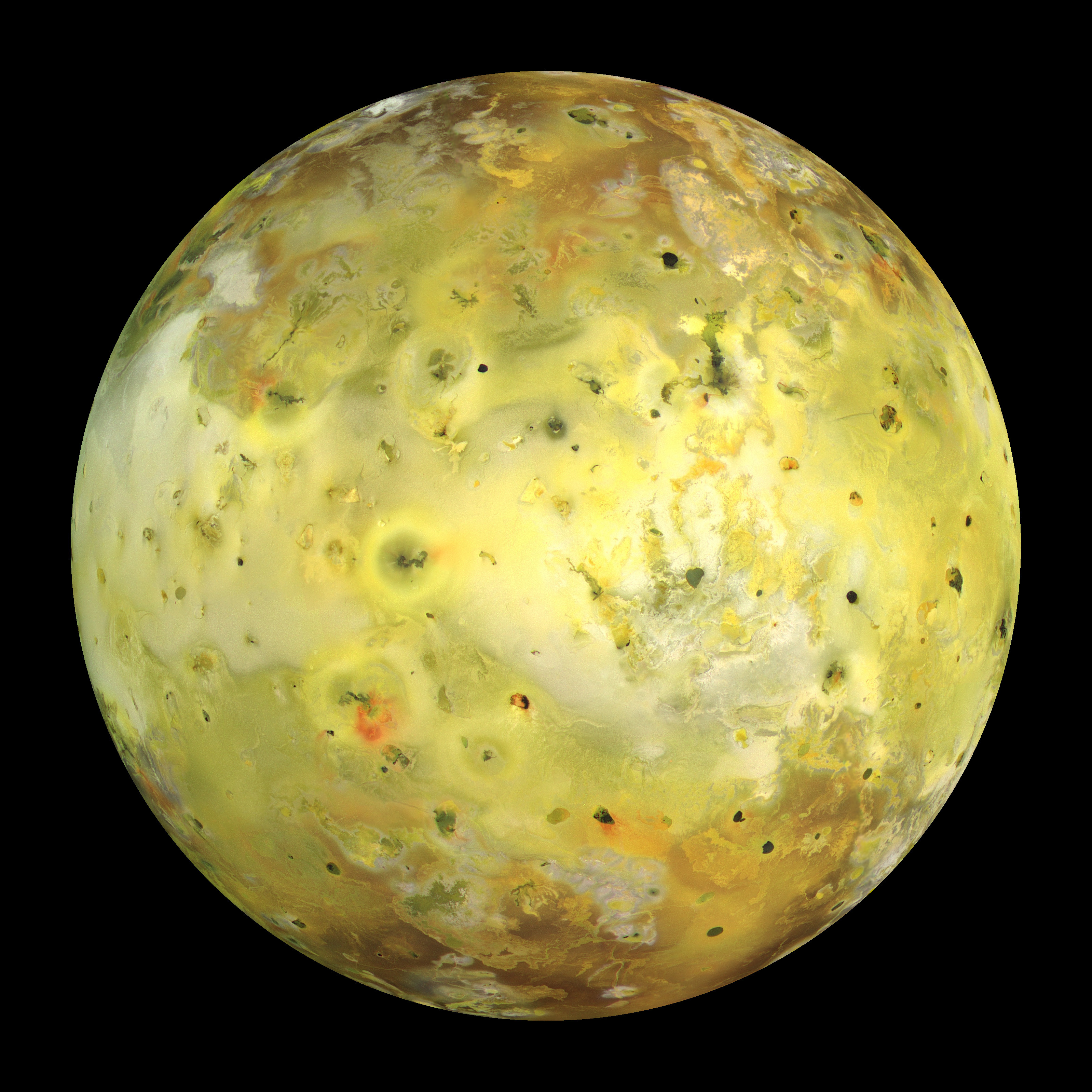
Jupiter's moon IO 
Io is the most volcanically active body in our solar system.Volcanic plumes rise about 190 miles above the surface. Io has over 400 active volcanoes. This extreme geologic activity is the result of tidal heating from friction from Io's interior. 
  
Jupiter's moon Callisto
Callisto is composed of rock and ices. The surface of Callisto is heavily cratered and very old. It does not show any signs of tectonic plates or volcanism.Some surface features are various amounts of impact craters and ridges.


As some of you may have notices Jupiter has a big red spot on it. Well that red spot is a big storm that has been going on for hundreds of years. 

Here are some differences between Jupiter and the inner planets.
Jupiter is bigger than the rest of the planets and none of the other planets have a big red spot/storm on them.


The reason Jupiter has stronger gravity than Earth is because Jupiter has only 254% of the gravity of Earth. This is because Jupiter is way bigger than our planet. 

My 5 Facts
1) Jupiter's red spot is a storm that has been going on fro hundreds of years.
2) Jupiter's moon Ganymede is is bigger than mercury.
3)Jupiter's moon Callisto is composed of rock and ices. 
4) There might be life on Europa.
5)Io is the most volcanically active body in our solar system.

Well thanks for reading my peace out peeps!
  

Thursday, December 5, 2013

Hello everyone and welcome to my blog! Today we are going to learn a bout Comets, meteoroids, meteors, and asteroids. But first we are going to learn about COMETS!!!


A comet is an object in space made of ice, dust, and when it gets close to the sun a tail of gas and dust particles form. It's speed in normally around 2,000 miles per hour but when it gets close to the sun it gets up to 100,000 miles per hour. That's really fast! The parts are nucleus, coma, and the tail.


Now we are going the explain the differences of meteoroids, meteors, and meteorites. One a meteoroid is a small body moving in our solar system. A meteor is when meteoroid enters the earth's atmosphere. A meteorite is when meteor hits the earth's surface.

Now we are going to talk about something awesome! Meteor showers! A meteor shower is a number of meteors that appear to radiate from one point in the sky at certain date each year.
 
 Asteroids are big pieces of rock that are in the Asteroid Belt between Mars and Jupiter. Asteroids are have some differences from comets though. Asteroids are made up of Metal and Rocky material, while comets are made up of ice and dust. Another different thing is that Asteroids form much closer to sun than comets because if comets form close to the sun the ice that they made up of would have melted. Also another different thing is that comets have tails and asteroids do not. Comets have longer orbital periods then asteroids.
 
Why study comets and asteroids you ask? Well scientists study them understand more about the origin of our solar system because asteroids are younger than sun and the same age as the planets and comets are the same age as the crest of our solar system so they can be good use for information. 
 
                                                                                   
                                                                     Fun Facts 
1) Scientists have found over 90,000 asteroids which are rocky remains from formation of the solar system.
2) Comets are some of least changed objects in space.
3) There are trillions of comets out there in space.
4) 750,000 asteroids in the asteroid belt.
                                                                   
                                                                         Link1
                                                                        link2
                                                                        Link3
                                                                        Link4


Friday, November 22, 2013

Hello welcome to another episode of M news we have breaking news story!!! There were 55 confirmed tornados in six different states! AAAAH!!
As of late Tuesday afternoon the weather chanel's analysis cinfirmed that were 55 confirmed tornados in six different states. Some damage surveys confirm that this could will likely be one the top five tornado out reaks in the U.S.              

                                  
                 This picture is totally not scary.

There was also an out break on Sunday too. More tornados from this storm oh my gosh! It was also one of the biggest out breaks in U.S. history acording to severe waether expert Dr.Gregg Forbes. On tornado in Michigan was a Efo tornado wasin the city Otsego michigan was the farthest north Michigan tornado in the year period of moderm tornados (1950) according to Nick Wiltgen a meteorologist for the weather channel.
  AAAAAAAAAAHHHHH!!!!!  
 
Tornados were also confirmed on that  day as far as Tennesee woth EF0 torados near Howell and Portland. There was also a tornado near Orlinda. I am so scared of tornados right now.
Geese more tornados!!
 
This story is important because a lot of people went throtgh this storm and it must have been scary for them because tornados are no laughing matter. I chose this story because weather intrest me and to me tornados are intrestng.
 
As this story develops I think what people are going to is start cleaning up the rubble and trash and find some of there belongings that the tornados left behind.
 
Here a question for you guys: how should you react if a tornado is heading your way do you panic or panic while going to saftey or be strong get to the right place.
  Answer : Be strong and get to the right place because you will be safer if you get saftey faster.